Three weeks of relentless US and Israeli airstrikes have gutted Iran’s military. Its supreme leader is dead, its air force crippled, and its navy largely destroyed.
Yet Tehran’s defiance shows no sign of fading.
Over the weekend, Iranian forces fired a volley of missiles toward Israel, striking near a nuclear research site and threatening to seal off the Strait of Hormuz — the world’s most vital energy artery.
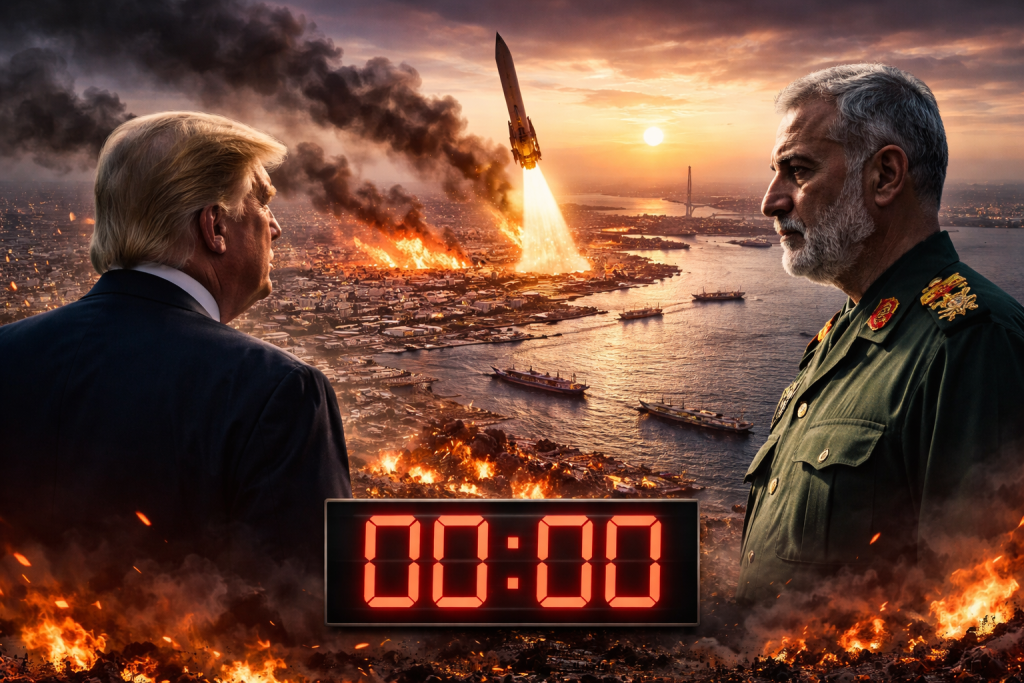
Now, as President Trump’s 48-hour ultimatum ticks down to its 7:44 p.m. Eastern deadline, global markets are holding their breath.
Oil prices have surged past crisis thresholds, airlines are scrambling to hedge rising fuel costs, and equities from Tokyo to London are convulsing under the weight of escalating tensions.
With trade routes in jeopardy and supply chains snarled, policymakers fear a single misstep could ignite not just a regional war — but a global economic shock.
Energy traders are treating every headline from the Gulf as a potential trigger for turmoil.
Brent crude has soared above $120 a barrel for the first time since 2022, with futures markets pricing in weeks of instability.
Major airlines have rerouted flights around Iranian and Iraqi airspace, driving up jet fuel demand and flight costs.
Shipping insurers have hiked premiums for tankers crossing the Persian Gulf, sending freight rates higher.
Stock markets are reeling.
The MSCI World Index has lost nearly 4% in two sessions, while the S&P 500 sinks under energy-driven volatility.
Investors are pulling back from emerging markets, favouring the dollar, gold, and longer-dated Treasuries.
Central banks, still wary of inflation, now face renewed price pressure from oil and transport costs.
Economists warn that a prolonged disruption in the Strait of Hormuz — conduit for nearly one-fifth of global oil trade — could derail fragile trade agreements and fracture the already uneven global recovery.
What triggered Trump’s 48-hour ultimatum?
The deadline came after one of the most dangerous weekends of the conflict. Iranian missiles broke through Israeli air defences on Saturday and struck the cities of Arad and Dimona, injuring around 100 people.
The IRGC said it targeted Israeli military sites in Dimona, Arad, Eilat, Beersheba and Kiryat Gat in its most destructive missile attack since the war began.
Dimona sits adjacent to Israel’s undisclosed nuclear research facility. Iran said the strikes were retaliation for an Israeli attack on the Natanz uranium enrichment complex. Israel denied hitting Natanz.
Trump responded on Truth Social within hours. He threatened to destroy Iran’s “various power plants, starting with the biggest one first” if Tehran did not fully reopen the Strait of Hormuz within 48 hours.
It came just one day after he said he was considering “winding down” the war — a reversal that rattled governments and markets simultaneously.
Iran’s response was to escalate
Tehran did not comply and instead issued counter-threats.
The IRGC declared, “if you strike electricity, we will strike electricity,” threatening to target power plants in Israel and any regional country supplying electricity to US military bases.
Iran’s armed forces went further, issuing their most alarming statement of the war: if power plants are struck, the Strait of Hormuz will be “completely closed and will not be opened until our destroyed power plants are rebuilt” — the first explicit threat of a total, permanent closure.
Iran’s foreign minister took a different angle publicly, writing on X that the Strait “is not closed” and that ships are hesitating because insurers fear the war, not because Iran is blocking them, telling Washington to “try respect.”
This framing gives Iran a theoretical face-saving off-ramp, claiming the Strait was never technically shut without conceding anything on the ground.
Meanwhile, Israel launched what it described as a “wide-scale wave of strikes targeting Iranian terror regime infrastructure” in Tehran on Monday morning, as the deadline clock continued to run.
Negotiations are real, but nowhere near a deal
Behind the ultimatums, there is a quiet diplomatic track. Kushner and Witkoff are involved in early internal discussions on what a potential deal might look like, with Egypt and Qatar passing messages between Washington and Tehran.
Iran has signalled interest in talks, but on tough terms. They want a ceasefire, guarantees the war will not resume, and compensation.
The US wants the opposite.
Zero uranium enrichment, an end to proxy funding, permanent missile restrictions, and an open Strait.
So far, there has been no direct contact between the two governments in recent days.
A direct communications channel between Witkoff and Iranian Foreign Minister Araghchi was briefly reactivated last week, though both sides dispute who initiated it, and Araghchi publicly denied the exchange entirely.
US officials now privately describe Araghchi as more of a “fax machine” than a genuine negotiator, and are still working to identify who actually holds decision-making power in Tehran after the killing of Khamenei and the removal of most of Iran’s top military and political leadership.
You cannot negotiate a deal if you do not know who can sign one.
What happens if war escalates further?
The economic pressure to resolve this is real and growing fast.
If the standoff escalates further, the market reaction could intensify quickly.
The IEA warned Monday that the energy crisis is now worse than the 1970s oil shocks, with more than 40 energy sites across nine countries severely damaged.
Brent crude is above $112 a barrel.
Analysts at Fitch said a six-month closure of the Strait of Hormuz could keep Brent around $120 a barrel on average.
BofA has also lifted its 2026 Brent forecast on the disruption, underscoring how quickly the crisis is feeding into pricing models.
Over 3,000 vessels remain stranded in the Gulf. Rising gasoline prices at home are creating political risk for Trump with midterms eight months away.
The pressure will spread well beyond energy.
European airline fuel prices have doubled, and Asian jet fuel prices are up almost 80% since the strikes began, while carriers are rerouting around Middle Eastern airspace and warning of higher fares and weaker earnings.
That is already feeding through to equities, with global stock markets sliding as oil volatility rattles investors and the S&P 500 coming under renewed pressure from energy-driven inflation fears.
In a prolonged escalation, the combination of dearer fuel, higher shipping insurance, and disrupted trade routes could squeeze corporate margins, weaken consumer spending, and force central banks into a harder choice between fighting inflation and supporting growth
Three scenarios are on the table tonight
Iran finds a face-saving formula — claiming the Strait was never formally closed — some ships move, and Trump claims a win while talks begin in earnest.
Trump softens or delays the threat, as he has done with past ultimatums, and the crisis drags on without resolution.
Or the US strikes Iranian power plants, Iran follows through on its pledge to shut Hormuz permanently and hit Gulf energy infrastructure, and a war that is already the worst energy shock in 50 years gets dramatically worse.
The Pentagon has asked Congress for an additional $200 billion for the war effort, and US Marines are currently heading to the Gulf, neither of which is consistent with winding down.
The clock runs out tonight.
The post Markets on alert as Trump’s 48-hour Iran deadline expires tonight appeared first on Invezz